Let’s walk together while listening to community radio
-Jeong Hyomin, South Korea
I work as a producer at a small community radio station in Busan, South Korea. Like terrestrial radio, we have our own frequency, so even in the age of AI, we provide radio service with basic electricity. Of course, if you have internet access, you can also listen through the app. From 7 a.m. to midnight, our broadcasts provide information and music almost continuously.
As I mentioned, radio is a very analog entity based on auditory information. However, radio opens up vast spaces in our daily lives and opens up various possibilities for experimentation. Incidentally, I’m listening to a radio broadcast as I write this. (At times like these, I somehow find myself wanting to listen to programs on other stations, not just my work radio!)
Unlike visual media, which require you to fixate on a screen with both visual and auditory information, radio’s greatest strength and appeal is that you can walk, move your hands, and do other things while keeping your ears open. Isn’t this a medium for everyone, easily accessible to everyone?
Unlike terrestrial radio, “community radio” highlights and reflects the characteristics of the broadcasting region. In Busan, a region with a rapidly increasing single-person household and aging population, one of the most striking features of community radio is the active participation of female producers and hosts.
Let’s first look at the numbers. As of September 2025, our community radio operates 24 programs. Surprisingly, 17 of these programs feature female producers and hosts. The women participating cover a wide range of age groups and topics.
“Kim Moon-joon and Park Jung-hee’s Classical Journey,” featuring a young female classical musician and a middle-aged female producer, introduces unfamiliar classical music to the public and occasionally invites performance producers for interviews.
“Kim Eun-jung’s Meet Now,” a program, invites guests from various professions to the studio and showcases diverse careers, focusing on female hosts, thereby challenging gender stereotypes.
Sometimes, the program’s title itself suggests a female-centered approach. “She’s Day, Their Chatroom” shares local news with useful parenting and education information for women in the community.
Another program is “Jeans(in Korean, 청바지).” The name “청”(youth) is derived from the first letters of “바” (right) and “지” (now). Combined, these three letters create “청바지,” or jeans. The content is filled with memories of women in their 60s, who call themselves still younger from their childhoods to their married children and grandchildren.
We take care to avoid bias toward a specific gender in both the production and execution; however, women’s participation in radio production and broadcasting is a fundamental strength of local radio.
This stems from women’s active participation, rooted in their communities and driven by a desire to represent their era and generation.
While women now have access to videos and information anytime, anywhere, through OTT platforms, they remain stuck in the passive consumption of pre-produced content. In contrast, producing content is a more active form of engagement. In the radio industry, for example, we hold meetings to select topics directly, serve as hosts, write scripts for a set amount each week, book guest appearances to encourage active conversation, and produce broadcasts for the allotted time.
Through these activities, women are broadening their media choices. They create and broadcast the content they want to hear receive feedback, incorporate it, and actively utilize it. Moreover, these accomplished female producers experience the changing seasons together through quarterly “community walks.” They share their thoughts on each other’s programs and even invite guests to join them.
I also grow through meeting these strong middle-aged women, as they enable connections that transcend generations. This summer, apart from recording sessions, I met a female producer outside the broadcasting station. It was like making a new friend, someone my mother’s age.
We visited the small village library she helped run, walked along a forest path in the city center, and shared a bowl of refreshing buckwheat noodles. We met through the radio, and we walked while listening to the radio.
This precious experience of working on local radio will soon come to an end. The beautiful music flowing from the broadcast and the thrill of live broadcasting will never be forgotten. Above all, the passion of the women comrades who shared their countless life experiences will remain in my memory for a long time.
Moreover, through the active media activity of ‘radio,’ I learned how to reveal, document, and share women’s lives. Unlike videos that require Wi-Fi to view, radio broadcasts transmitted through radio frequencies are recorded in the universe. It is like an eternal record of time. Now, shall we listen to local radio together?
Selecting music and coordinating with the host outside the radio booth
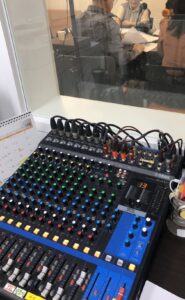
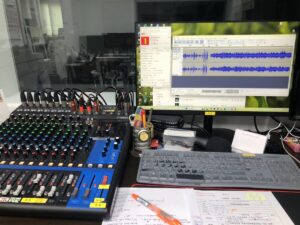
A radio mixer used for recording broadcasts
【Profile】
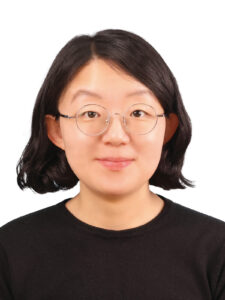
Jeong Hyomin
Majoring in Sociology and Social Economy,
Jeong Hyomin is an activist researcher
working through local media with a focus on
Asia and women’s empowerment. She
creates alternative maps through community
mapping initiatives, amplifying local voices
and perspectives. Previously, she worked as
a Producer at Yeonje FM Community Radio
(http://115.68.193.176:8000/yeonjefm).
On our SNS, we post the latest information, including announcements of Asian Breeze. Please follow us. Click on the icon to jump to the page.